You Don’t Need $325,000 to Buy a $325,000 House: A First-Time Home Buyer’s Guide
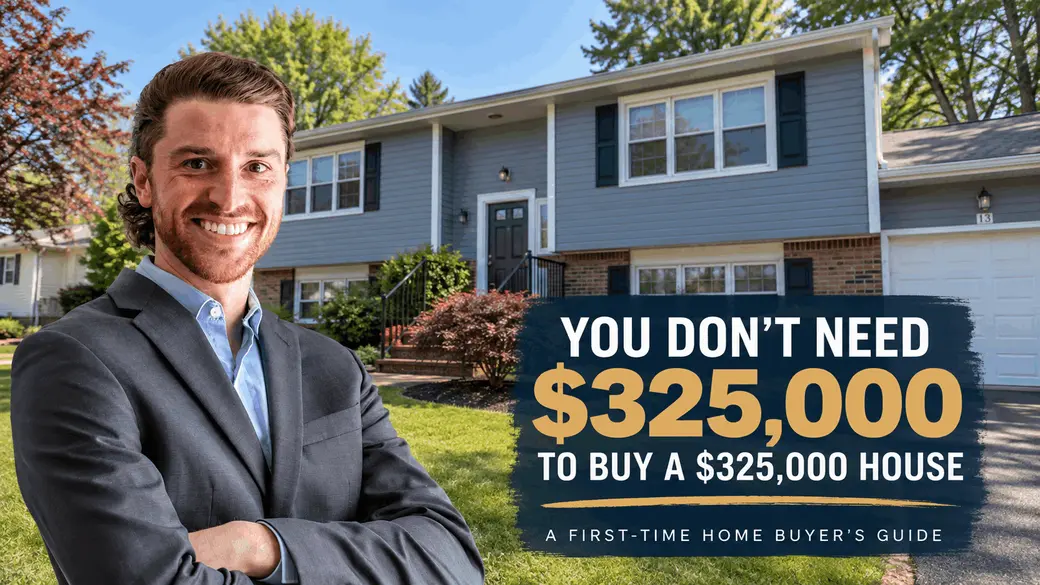
One of the biggest misconceptions I hear from first-time home buyers is that you need hundreds of thousands of dollars sitting in the bank before you can even think about buying a house.
I understand where that idea comes from.
You scroll through real estate websites and see houses listed for $250,000, $300,000 or $400,000. You hear people constantly talking about how expensive homes have become. Maybe you read another headline about mortgage rates or housing affordability.
Eventually, buying your first home starts to feel impossible before you've even learned how buying a house actually works.
But here's one of the first things I want new buyers to understand: The purchase price of a house and the amount of cash you need to purchase that house are two completely different numbers.
I recently toured a home in Liverpool, New York listed around $325,000, and it gave me a perfect real-world example to explain this.
Rather than just showing you another house, let's use it to talk about how financing works, why your credit matters and why understanding the numbers is more useful than automatically assuming homeownership is out of reach.
First, Let's Look at the House
Instead of creating a hypothetical example, let's use an actual Central New York property.
At the time I toured this Liverpool home, it was listed at approximately $325,000.
Listing Provided Courtesy of Briana Payne with Real Broker NY
I also filmed a quick walkthrough so you can see what a home around this price point can look like in the Syracuse-area market:
CLICK HERE TO WATCH THE HOUSE TOUR NOW
Now imagine you're a first-time buyer watching that video.
You like the house.
Then you hear: $325,000.
And immediately you think: "There's no way I have that kind of money."
You probably don't have $325,000 sitting in your checking account.
Most buyers don't need to. That's the entire point.
You Don't Necessarily Need $325,000 in the Bank to Buy a $325,000 House
Unless you're purchasing a property entirely with cash, you're generally financing at least a portion of the purchase.
Depending on your qualifications, the property and the mortgage program you're using, your required down payment could represent a relatively small percentage of the total purchase price.
That's one of the most important concepts to understand about real estate:
Financing can allow you to purchase an asset without paying its entire purchase price upfront.
A lender provides the financed portion of the purchase price. You provide the required down payment and other funds necessary to close, and then repay the mortgage according to the terms of your loan. That's leverage.
It can be an incredibly useful financial tool when used responsibly, which is why I believe understanding credit, mortgages and banking should be part of the conversation long before you start scheduling showings.
So What Could Buying a $325,000 House Actually Look Like?
I made a second video at this same property specifically to talk about the financial side:
CLICK HERE TO WATCH MY FIRST-TIME BUYER FINANCIAL BREAKDOWN SHORT ON YOUTUBE
Let's use a very simple example.
Suppose a qualified buyer used a mortgage program requiring a 5% down payment on a $325,000 purchase.
Five percent of $325,000 is: $16,250
That's obviously very different from $325,000.
However, the down payment isn't necessarily the only money a buyer needs.
Depending on the transaction, there can also be lender fees, attorney fees, inspection and appraisal expenses, prepaid homeowners insurance, property-tax and insurance escrows and other closing-related expenses.
In my video, I used a deliberately conservative 11% planning exercise: 5% for the hypothetical down payment and an additional 6% cushion to illustrate that buyers should plan for expenses beyond the down payment.
Eleven percent of $325,000 would equal: $35,750
That does not mean it costs $35,750 to purchase every $325,000 home.
And it does not mean closing costs are always 6%. They're not.
I'm intentionally using a large cushion because this is an educational example - not a Loan Estimate or quote.
Actual cash needed could be substantially different depending on your loan program, lender, credit profile, taxes, insurance, prepaid expenses, property, negotiated seller concessions, available assistance programs and other factors.
The bigger lesson is the difference between thinking: “I need $325,000 to buy that house.”
and asking: “What financing might I qualify for, how much cash would I actually need to close, and what would my monthly payment be?”
Those are much better questions.
Before You Worry About Home Prices, Learn How Credit Works
I think we sometimes start the home-buying conversation backward.
Everyone wants to know: “How much house can I afford?”
That's important.
But if you're months - or even years - away from buying, I'd start with something simpler:
Learn how credit works.
Understand the factors that can affect your credit profile.
Pay your obligations on time.
Understand credit utilization.
Be thoughtful about taking on unnecessary debt.
Review your credit reports periodically and address legitimate errors when you find them.
You don't need to become a credit expert or mortgage professional.
But your financial decisions today can affect the financing opportunities available to you later.
And you don't need to wait until you've found the perfect house to start learning.
In fact, I'd much rather have someone start asking questions a year too early than a week too late.
Learn How Banks and Mortgages Actually Work
I think debt gets painted with too broad of a brush sometimes.
Debt is a financial obligation, and borrowing money always comes with costs and risks.
But there's a difference between blindly taking on debt and deliberately using financing to acquire an asset you believe makes sense for your financial situation.
A mortgage can allow a qualified buyer to purchase a $200,000, $300,000 or $400,000 property without first accumulating the entire purchase price in cash. That doesn't make the house free.
You still have a mortgage payment. You're paying interest. There are property taxes, insurance, maintenance, repairs and other costs of ownership.
Property values can also decline. A house isn't guaranteed to appreciate, and no real estate investment is guaranteed to be profitable.
But over time, your mortgage payments can reduce the principal balance you owe. If the property's market value also increases, those two factors can contribute to additional equity.
That's the long-term side of real estate that interests me.
Not buying a house because someone on social media promised you'll get rich.
Not assuming every property is automatically a good investment.
Understanding how financing works, buying something that makes sense for your circumstances and giving yourself time.
Your First Home Doesn't Have to Be a Home Run
Social media has distorted this part of real estate too.
Every property doesn't need to be an unbelievable investment.
You don't necessarily need to find a foreclosure, renovate the entire house, turn half of it into an Airbnb and somehow make $150,000 in twelve months.
Sometimes your first house can simply be...your first house.
You purchase something you can reasonably afford. You maintain it.
Maybe you improve it over time. You make your mortgage payments. You learn how homeownership works.
And if you own the property long enough, you give yourself time to pay down your mortgage and potentially benefit from changes in the property's value. There are no guarantees.
People can overpay. Property values can fall. Repairs can be expensive. Life circumstances can change. And buying a house that stretches your finances too far can create problems regardless of what the market does.
That's why I'm such a believer in running the numbers, understanding the property, studying your local market and thinking long term.
The goal shouldn't be convincing yourself that every house is a great investment.
The goal is becoming educated enough to determine whether a particular purchase makes sense for you.
I've Been on Both Sides of This
One reason I'm passionate about explaining this stuff is because I haven't only experienced real estate as an agent.
I've purchased multiple properties myself. I've been the person applying for financing. I've gone through underwriting. I've paid for inspections. I've waited for appraisals. I've transferred money for closing. I've sat at the closing table.
And I've dealt with the maintenance and repairs that come after becoming the owner.
So when a first-time buyer tells me the process feels overwhelming, I understand why.
Real estate agents, lenders and attorneys deal with this terminology every day.
First-time buyers don't.
Nobody should expect you to automatically understand down payments, mortgage insurance, interest rates, escrows, prepaids, inspections, appraisals and closing costs when you've never purchased a house before.
That's why I believe: Education should come before house hunting.
The Price of the House Isn't the Only Number That Matters
Let's say a lender approves you to purchase a $325,000 home. Great.
That doesn't automatically mean you should spend $325,000.
I think buyers need to understand at least two major numbers:
1. How much cash will I actually need to complete the purchase?
And:
2. What will owning this house actually cost me each month?
Your monthly housing expense may include much more than mortgage principal and interest.
Depending on your financing and property, you could also have property taxes, homeowners insurance, mortgage insurance, HOA fees and other expenses.
Then there are costs that don't appear in your mortgage payment.
Eventually, something breaks. A roof doesn't last forever. Neither does a furnace. Homeownership comes with responsibility.
So I don't think your goal should simply be: “What's the absolute maximum a lender will let me borrow?”
I'd rather ask: “What can I comfortably afford while still being able to live the life I want to live?”
Those are very different questions.
You May Be Closer Than You Think - Or You May Have Some Work to Do
I'm not saying everyone reading this should buy a house tomorrow. Some people probably shouldn't.
Maybe improving your credit should come first. Maybe you need to pay down debt. Maybe you want a larger emergency fund. Maybe your income isn't where you want it yet. Maybe you're planning to move in two years. Or maybe renting simply makes more sense for your current lifestyle.
All of those can be perfectly reasonable outcomes.
What I don't want someone to do is spend the next five years assuming homeownership is impossible simply because houses cost $300,000 and they don't have $300,000.
Learn how the process works before you eliminate the possibility.
Understand your credit. Talk with a qualified lender about your actual financing options. Start saving. Learn how mortgages work. Pay attention to your local real estate market. Ask questions. Build relationships with professionals you trust before you urgently need them. You may discover that you're not financially ready yet.
That's valuable information.
Or you may discover that the gap between where you are today and purchasing your first home is smaller than you assumed.
That's valuable information too.
Either way, you're making decisions based on real numbers instead of assumptions.
First-Time Home Buyer FAQs
Do I need 20% down to buy a house?
Not necessarily. Down-payment requirements vary based on the mortgage program, borrower qualifications and other factors. Some financing programs permit qualified borrowers to purchase with less than 20% down.
How much money do I need to buy a $325,000 house?
There isn't one universal answer. Your required down payment, financing, closing expenses, prepaid expenses, taxes, insurance, negotiated credits and other factors can all affect your cash needed to close.
The $35,750 figure used in this article is simply a conservative educational example - not a quote or representation of what a particular buyer will need.
Is my down payment the same as my closing costs?
No. Your down payment is the portion of the purchase price you're contributing toward the purchase rather than financing. Other transaction expenses, escrows and prepaid items can result in additional cash being required.
Should I talk to a lender before looking at houses?
It can be extremely helpful. A qualified mortgage professional can evaluate your individual financial circumstances and explain the financing programs for which you may qualify. Even if you're not purchasing immediately, understanding your position can help you establish a realistic plan.
What if my credit isn't where it needs to be?
Finding that out early gives you time to understand the factors affecting your credit and develop a plan. Be cautious of anyone promising guaranteed or instant credit-score improvements.
Are there first-time home buyer programs in New York?
Yes, New York has programs designed to assist eligible home buyers, but eligibility, funding and program terms vary and can change. For example, SONYMA offers mortgage and down-payment-assistance programs subject to income, purchase-price, location and other requirements. Buyers should verify current programs and eligibility directly with participating lenders or the appropriate program administrator.
Start With Education, Not House Hunting
Looking at houses is fun. I literally do it for a living. But if you're serious about eventually buying your first home, one of the most valuable things you can do is learn the fundamentals before falling in love with a property.
Learn about credit. Learn about mortgages. Learn what cash-to-close means. Learn how monthly payments are calculated. Learn about your local market. And start building relationships with qualified professionals who can answer your questions before you urgently need those answers.
You don't need to know everything today. You just need to start learning. Because the biggest thing separating some people from homeownership isn't necessarily another $200,000 sitting in their savings account.
Sometimes it's simply understanding how the process works.
This article is for general educational purposes only and is not financial, lending, tax, legal or investment advice. Mortgage programs, rates, qualification requirements, closing costs and required funds vary by borrower, lender, property and transaction. Consult the appropriate licensed professionals regarding your individual circumstances.
Categories
Recent Posts






GET MORE INFORMATION